
Main Image by Femke Haitsma Mulier
The Rijssens Museum is located in the small Dutch town of Rijssen and has been housed in the historic manor house De Oosterhof since 1988. The museum traces its origins to the Stichting Oudheidkamer Riessen (Riessen Antiquities Foundation), established in 1951 following a successful exhibition celebrating the town’s 700th anniversary. The enthusiastic public response highlighted the importance of preserving Rijssen’s cultural heritage and ultimately led to the creation of a permanent museum. Today, it presents the history of Rijssen through archaeology, local traditions, the textile industry, and one of the town’s greatest cultural treasures: the Van Heel Collection.

De Oosterhof is a historic havezate (moated manor house) whose origins date back to the early fourteenth century. First mentioned in 1324, it remained in the hands of several prominent noble families for centuries. Much of the building’s present appearance dates from eighteenth-century alterations.
At the heart of the museum is the Van Heel Collection, assembled by Marin Gerard van Heel (1876–1950) and his wife Gertrud J.M. Willems. Born in Nijverdal, Van Heel grew up in Rijssen after the death of his father. His mother’s family, the Ter Horsts, were among the founders of Ter Horst & Co., the jute manufacturing company that transformed Rijssen into one of the Netherlands’ leading textile centers. After completing a technical education in England, Van Heel joined the family business, eventually becoming one of its partners.
Van Heel’s fascination with antiques began at an early age. Rather than relying exclusively on established dealers, he spent years exploring farms and country houses throughout Twente in search of early pottery, pewter, and other historic objects. These expeditions were often undertaken with Izak (Izaak) Vomberg (1853–1943), a respected Jewish art and antiques dealer from Rijssen whose exceptional eye for quality and extensive knowledge of decorative arts proved invaluable in shaping the collection. Acting as both advisor and purchasing agent, Vomberg helped Van Heel acquire many outstanding objects.

Although Van Heel became an important Dutch collector, he remained a remarkably modest figure. Contemporary accounts describe him as a discerning connoisseur who preferred scholarship over publicity and generously shared his expertise with fellow collectors, museum professionals, and researchers.
Over several decades, Van Heel assembled an exceptional collection that included seventeenth- and eighteenth-century Dutch Delftware, Old Master paintings, silver, glass, clocks, jewelry, and miniature works of art. Following his death in 1950, his widow honored his wishes by donating the greater part of the collection to the Stichting Oudheidkamer Riessen, ensuring that it would remain accessible to the public.
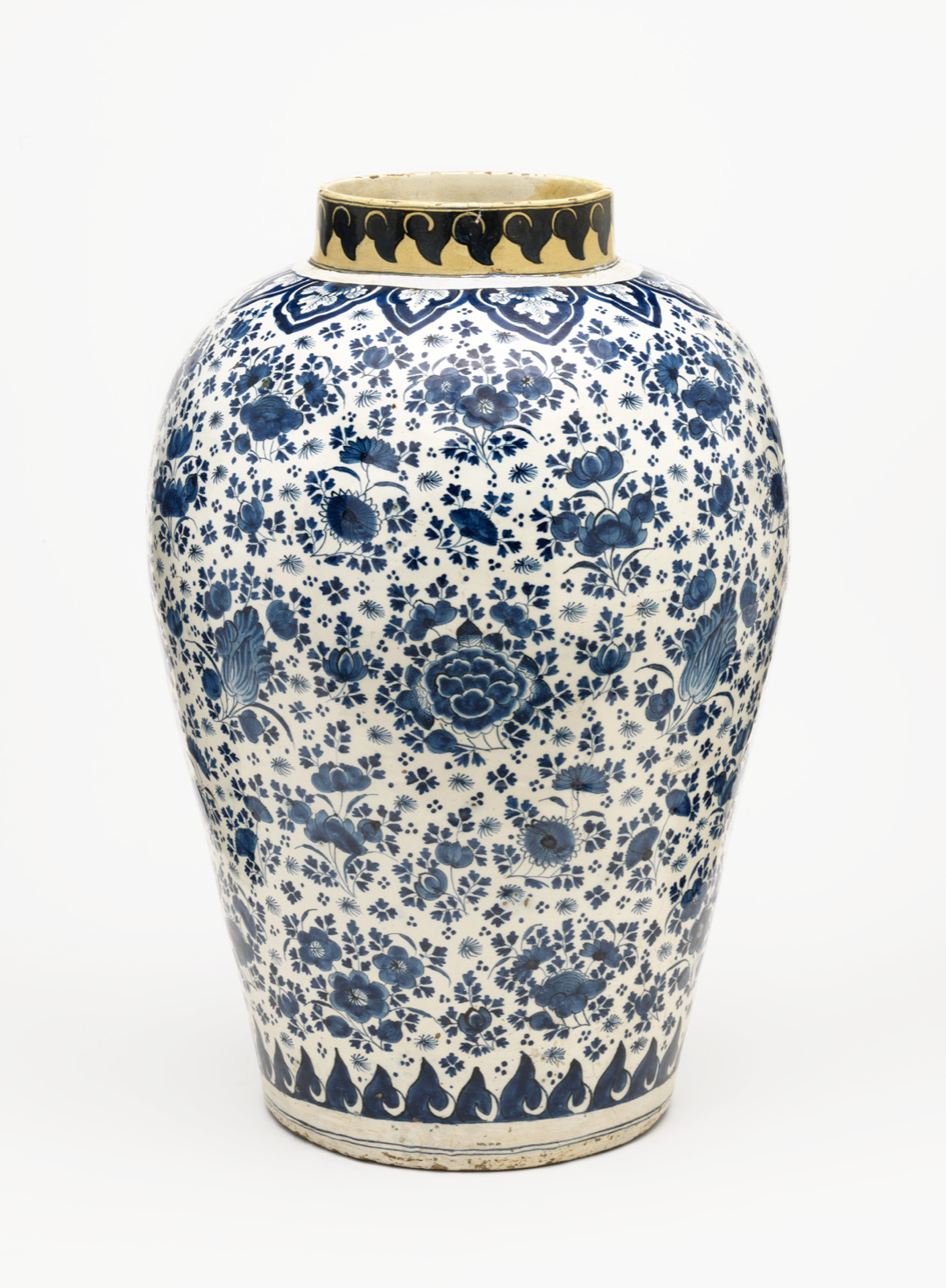
With more than 225 objects, Dutch Delftware forms one of the principal strengths of the Van Heel Collection. Since 1967, much of the collection has been on long-term loan to Rijksmuseum Twenthe. Today, in collaboration with Rijksmuseum Twenthe, a selection of these objects is displayed in the Rijssens Museum.
Among the Delftware highlights are several eighteenth-century figures, plates, and vases, as well as a rare money bank dated 1743 (Fig. 1). Inscribed “Hier trekt men omt / Hoogste nomer” and bearing the initials H V MD on the underside, it is one of the few surviving Delft faience money banks. Even rarer is a polychrome candlestick modeled as a tree trunk with leafy branches and marked HB for Hugo Brouwer, owner of De Drie Porceleyne Flessies (The Three Porcelain Bottles) between 1761 and 1777 (Fig. 2). Another highlight is a petit feu enamelled and gilt tobacco jar (Fig. 3), decorated with landscapes framed by floral scrollwork and surmounted by a tulip-shaped finial. It beautifully illustrates how the fashionable Rococo style of Meissen porcelain was successfully adapted to a distinctly Dutch Delftware form.
The Rijssens Museum is well worth a visit for anyone with an interest in Dutch Delftware and the history of collecting.




 CHINESE 阿伦森 WEBSITE