Skip to content

Polychrome Figural Wine Cistern

Each month, we highlight a special object from the Aronson Antiquairs collection. As October ushers in the wine season, our attention turns to an exceptional 1754 dated wine cistern, intriguingly inscribed ‘Bordiau,’ most likely a reference to Bordeaux wine. Marked P:V:M 12 : ST in blue for Petrus van Marum, the owner of De Romeyn…

The Man Behind the Label: Ole Olsen and His Passion for Delftware

A small paper label preserved inside a Delft faience bust provides the starting point for the story of its former owner, the Danish collector Ole Olsen (1863–1943) (main Image). Dating from the early twentieth century, the label depicts an intriguing figure: a gentleman carefully examining an object through a magnifying glass. A collectors label always…

“Mijn Jaer Is Om”: Barbering and the Delftware Barber’s Bowl

Main Image: Barber Bowl, Delft, circa 1700, Aronson Antiquairs (inv. no. 25093) Genesis 41:14 recounts how Joseph, summoned from prison to appear before the Pharaoh, first shaved and changed into clean garments before entering the royal court. Although brief, the passage illustrates that shaving has long been associated with cleanliness, respectability, and social identity. Throughout…

D2092 Delftware Barbers Bowl

Blue and White Oval Barber’s Bowl

Every month we present a special object from the Aronson Antiquairs’ collection. This month we would like to show you this blue and white oval barber’s bowl. It was made around 1760 at De Porceleyne Byl (The Porcelain Axe) factory in the city of Delft. Other than often assumed, the round or oval depression at the…

D2518 Blue and White Pear-Shaped Vase Delft, circa 1680

Blue and White Pear-Shaped Vase

Each month, we highlight a special object from the Aronson Antiquairs collection. This month, we are pleased to present this rare, early pear-shaped vase, made around 1680 at the renowned De Grieksche A (The Greek A) factory in Delft. Although Delft potters had begun experimenting with ways to replicate Chinese porcelain as early as the…

D2621 Blue and White Cruet Set Delft, circa 1700

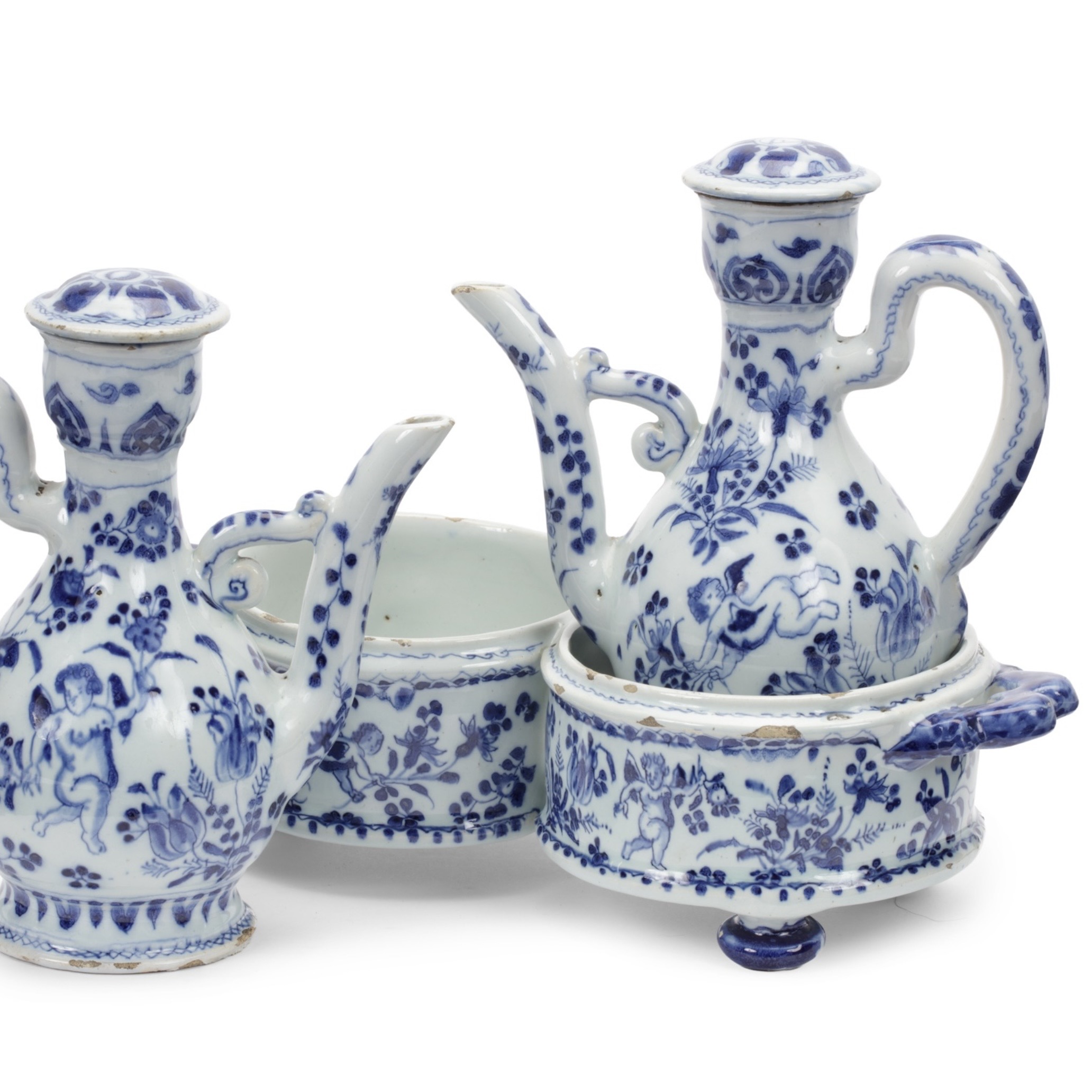
Blue and White Cruet Set

Each month, we highlight a special object from the Aronson Antiquairs collection. This month, we are pleased to present this blue and white cruet set. Among the most elegant expressions of Delft ceramics produced around 1700 are objects intended for the dining table. This refined cruet set, made at the celebrated De Roos (The Rose)…

Delft Cruet Stands: Form, Function, and Context

Oil and vinegar sets, commonly referred to as cruet sets, are among the more telling additions to the early modern dining table. Their emergence marks a shift toward more structured dining, in which individual elements assumed a defined role in both presentation and use. In the seventeenth and early eighteenth centuries, dining in Europe became…

Pair of Blue and White Royal Portrait Trays Delft, circa 1750

Pair of Blue and White Royal Portrait Trays

Each month, we highlight a special object from the Aronson Antiquairs collection. This month, we are pleased to present a pair of blue and white royal portrait trays. This exceptional pair of Delft trays presents a refined and politically charged homage to Prince William IV, Stadtholder of the United Provinces, and his consort, Princess Anne…

Back To Top
X